
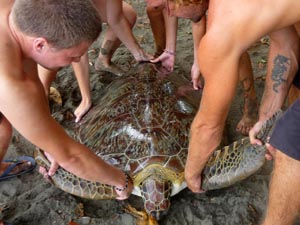
Volunteering in Costa Rica: Turtle Project
Volunteers will work with the endangered Olive Ridley turtles along the gorgeous coastlines of Costa Rica. Both species' populations are in sharp decline due to over harvesting of eggs, beach development, fishing, pollution, and being killed for their meat and leather. The programs give you the chance to make an important contribution to the preservation of these species, assisting local communities who carry out conservation work and gaining first-hand knowledge into Costa Rica's biodiversity and culture.
Turtle Program
Volunteers will provide support to biologists, biology interns and / or locals who are involved in managing the Olive Ridley turtles nesting grounds. Volunteers will take part in the following activities:
- Nightly beach patrols
- Tagging turtles
- Relocating nests into hatcheries
- Counting eggs
- Counting turtles
Volunteers will be working with a very poor local population as part of the project, in a very rural setting. The projects are located on gorgeous Pacific coast beaches, where swimming, surfing and local culture flourishes.
Note: These projects normally include sustainable egg harvesting programs that feed or provide income to the local communities. These programs are designed to prevent other forms of harvesting and poaching, and are overseen by the Costa Rican government.
Accommodation
For those volunteering in the Turtle conservation program, you will be accommodated in either a local family-stay or on reserve accommodation, and you will be located on either the Pacific or Caribbean coastline, depending on the turtle season. All families selected for this are pre-approved, and the program fees cover breakfast, lunch, and dinner from Monday through to Sunday. Most family-stays include a shared room and shared bath facilities, and many of the families have been hosting volunteers for years.
Meals and Food
Local Costa Rican food is provided three times a day for participants at family-stays. Costa Rican food is a fusion cuisine. It combines elements of culinary traditions from Africa, Italy, France, China, and Spain, flavoured by traditional grains (rice, corn, and beans), roots sweet potatoes), spices (coriander, garlic, annatto, saffron, parsley, oregano, thyme, nutmeg, salt, and pepper), oils (olive oil, vegetable oil, and lard), sauces (Soy, and Worcestershire), fresh fruit, and vegetables. The food is mild to slightly seasoned.
Free Time
Working hours are often long and difficult, and include night shifts and early morning hours. Beach patrols require a lot of walking and volunteers should be physically fit and prepared for this.
It is very important to note that in the Turtle program volunteers only have 1 day off per week, and in most projects volunteers are not allowed to leave the reserves during the week.
Communication
Free internet is available for volunteers to use at our partner's headquarters. Internet cafés are widely available in San Jose.
For those volunteering on the Turtle program, we recommend purchasing a phone card upon arrival, as cell phone coverage on the beaches can be very limited.
Number of Volunteers
The Costa Rica program usually has between 15 and 40 volunteers per month, but the number of volunteers varies depending on the season. Generally you are placed with one to three other volunteers at your project.
 Kenya.
  Vietnam.
  Peru.
Peru.  Nepal.


